Religion played an important part
in the Roman garden, and the garden mainly served as a way to worship and
dignify the gods. Most places had a “house god” that looked after the physical
property and the inhabitants of the house. The garden usually contained small
statues to this god, and served as a way to connect the people to their god, as
well as a place to give offerings to their god. Larger roman gardens,
frequently found at beautiful villas, often contained larger statues of
important religious figures, like Venus, or murals, which allowed the Romans to
further connect with their gods by depicting sacro-religious scenes.
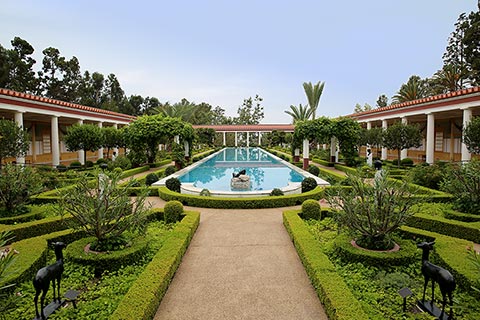
Roman garden
During the medieval times, the
church gained massive influence throughout the continent. Even though monks
initially travelled throughout Europe with the hope of spreading religion, the
church soon morphed into a powerful state. The Church began to transform, and
soon demanded, under the threat of eternal damnation, that churchgoers support
the church monetarily; this allowed the church to become massively powerful and
rich, spreading their influence throughout the continent. The influence of the
church is easily seen in the medieval gardens, where there are quite obvious
allusions to the Garden of Eden. The gardens from this time period were largely
cruciform, with a central fountain that led to four smaller rills, which represent
the 4 rivers from Eden: the Pishon, Gihon, Tigris, and Euphrates. But perhaps
even more obvious symbolism can be found in the Mary Garden, a popular concept
for the medieval times, particularly the rich. This small, enclosed garden was
not a place for medieval merriment, but instead a small space for quiet,
spiritual reflection. The garden featured a prominent, and often central,
statue of Mary, and was an escape from the hectic and dirty life of a castle or
manor house. Plus, characteristic flowers, like the white lily and red rose,
further symbolize the purity and innocence of Mary and the Passion of her son
Jesus, respectively.


The Medieval garden- notice the A representation of the Mary garden
simple practicality of the garden,
as well as the raised beds


But while medieval gardens do show
an allusion to religion, it is perhaps even more obvious in the Muslim gardens.
Like Christianity, the Muslim religion places significant emphasis on gardens;
in the afterlife, the Arabs believe, good people go to a paradise garden,
similar to that of the Garden of Eden. This garden is beautiful, cool, and has
plenty of colorful flowers, which is in direct contrast to the hot, dusty, and
dry life of the Moorish people. Thus, most Muslim gardens were designed as a
mini version of this paradise. And paradise they are. Since it is believed that
all forms of beauty are a way to worship Allah, Muslim gardens are particularly
beautiful and intricate. These gardens were usually centered around beautiful
water features, along with colorful flowers in raised beds. Like the medieval
gardens, Arabic gardens also feature a central found that feeds into four
rills, although these rills represent the four rivers of life: milk, honey,
water, and wine. The garden was frequently surrounded by a wall, which had
paintings or tapestries or beautiful religious pictures, as well intricate
calligraphy that referred to the strength and power of the Allah; this
beautiful artwork also represented the dedication of the garden owner to the
Almighty.

Islamic Gardens; The Alhambra is perhaps the most famous example (right)
Sources
Mary garden: http://www.catholiccompany.com/blog/wp-content/uploads/2012/05/2.jpg
Alhambra: https://blogger.googleusercontent.com/img/b/R29vZ2xl/AVvXsEhU-c67f7YSNIGhZih5fFW1DSU355SXb3jGxBdlQrNQ0NcpFuWhKxOlmwB28qgWs3jiDpGxivLCgNWNaTgYA9yhg5ZXP_Fuijb4HKr3IRMr0u854bGWVW3RAw9Wj8lQAJlgpHBhvRAsiqlr/s1600/alhambra-Garden.jpg

I think it is also cool that Islamic gardens incorporated calligraphy to explicitly state the link between religion and the garden, which is very different from the implicit way Christianity incorporated religion in the garden.
ReplyDeleteBut there is the overlap of using a garden as a location for personal reflection and to examination of one's relationship with God, one of the roles and puposes of both the Islamic garden and, for example the monastic cloister garth.
ReplyDelete