Wednesday, April 30, 2014

Battle of Style

The Battle of Styles is an apt name for a period of change that was occurring in gardens during the late 19th century. The ‘battle’ in the Battle of Styles was real, as William Robinson and Reginald Blomfeld, the two main opponents, somewhat viciously attacked each other, in an attempt to win the war. Ironically, this was probably unnecessary, as both men could have been united in their common enemy: the Victorian garden. Yet they instead traded harsh criticism in magazines and book forewords, each more biting than the last.
A Robinson garden, with numerous hardy plants

On one side of the battle was William Robinson, a well-known gardener that strongly favored the natural over the artificial. He shunned the use of geometric shapes and excessive fountains or statues, and harshly criticized Versailles, considered among the nicest gardens in the world, as “unlovely.” Unsurprisingly, then, his gardens featured a lighter touch; he used plants and shrubbery to add color and drama to his gardens, while foregoing elaborate statues and water features. His gardens also featured some shrubs and trees, which also required minimal maintenance. These shrubs were used for simple borders, and he detested the formality of patterned hedges and topiary, as well as the use of greenhouses to grow tropical plants.
He primarily used hardy plants, like fennel and reeds, to create a colorful, complex garden that required little upkeep. These plants could easily survive the winter, and then flower the next spring, even if forgotten. His use of these plants earned him the nickname of the ‘practical gardener,’ which may have stemmed from his simple Irish upbringing. Although little is definitively known about his childhood, it is believed that he grew up on a small farm in Ireland, and likely had a relatively modest childhood. Thus, a garden that required little upkeep would have seen especially attractive to a boy that was likely kept busy with family chores. Indeed he used so many plants that the soil was essentially totally covered, preventing weeds from growing. The result was quite simply beautiful—a sea of flowers with different colors, patterns, and heights that made for an elaborate garden that appeared like a natural field of flowers.
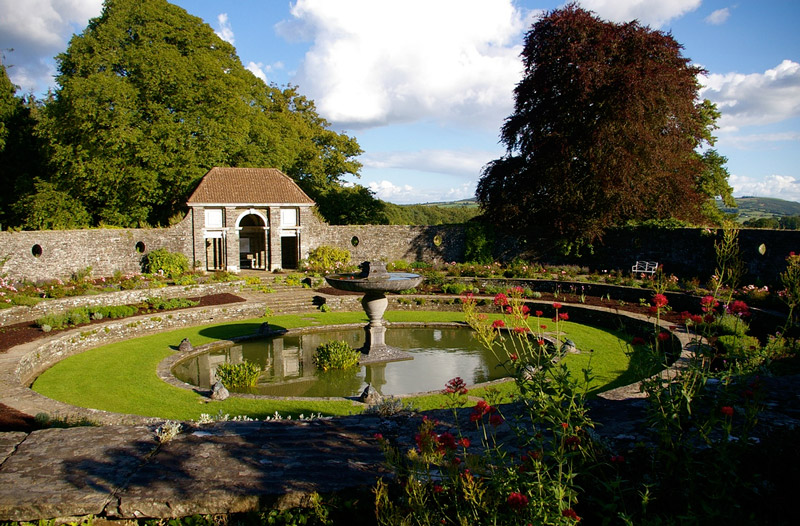
A more formal Blomfield garden, note the straight lines and classical architecture

            The other side of the debate featured Reginald Blomfield, an architect who, naturally, thought that gardens should be designed by the architect, and not the gardener. This led to gardens that were more formal and elaborate, and integrated into the architecture of the house. Blomfield found his inspiration in both the French and Italian Renaissance, and he correspondingly favored very formal gardens. These gardens featured straight lines, carefully arranged flowers, and clipped hedges. Together, this created a “homogenous result” that closely linked the house and the garden together. These gardens were large, and featured numerous terraces, as well as a variety of vases, sundials, and Renaissance-inspired statues, which were universally despised by Robinson. This made the garden more like a piece of art, and it appeared more stylized and designed than Robinson’s garden.

Who won the battle? Probably neither. It could be argued that Robinson won, as public sentiment was clearly on his side. The English Flower garden flourished in houses around England, and the popularity of densely packed gardens filled with hearty plants increase dramatically, and is still seen today. However, Robinson continued to berate architects for much of his life, accusing them of having no skill, which lessen his respect within the community. And indeed many architects did have prodigious skill, but would need a gardener to actually care for the plants. Perhaps, then, the battle was really a draw, and that neither could excel without the other.  Eventually, a partnership would arise between gardener and architect, again proving that working together is a better alternative than working apart. That is not to say that Blomfield and Robinson ever worked together, instead it would take a new architect-gardener pair, Jekyll and Lutyens, to form a team that would revolutionize gardening and create the arts and crafts garden.

The winner of the battle- Jekyll and Blomfield gardens

Saturday, April 19, 2014

The Crucial Importance of Urban Greenspace

Urban greenspace provides city dwellers with a vital escape from the hustle and bustle of daily life. In impersonal cities that are dominated by businesses and money, these spaces provide a welcome respite from the city. Perhaps most obviously, parks provide a way to appreciate the beauty of nature. Most parks are beautifully designed and maintained, with a large variety of plants and trees, and many have a lake or water features. These places are simply beautiful, and are strong juxtaposed against the backdrop of grey city buildings. Many parks feature beautiful man-made vistas that seem to make the city disappear, and provide an ideal place for having a picnic or studying outside on a warm day. 

Greenspace provides a perfect place for a lovely picnic with
friends or family
Exercising is much easier in this park than in the city

In addition to simply beautifying the city, parks also provide a great place for local residents to walk and exercise. It is notoriously difficult to exercise in cities, as the maze of tourists and traffic can be difficult to navigate, so parks serve a vital purpose and can even improve health. In a recent scientific study, city dwellers that have easy access (within about 15 minutes) to greenspace are significantly healthier and have lower medical expenses than residents that live farther away from a park or other natural area. This is also true on the macroscopic level, as cities with the largest amount of greenspace also have some of the healthiest inhabitants, as measured by the incidence of, and spending on, common diseases, like hypertension and cancer. These studies unequivocally show the health benefits of the park, although the reason for these benefits is no entirely less clear. It is likely at least partially related to increased exercise, as most people actually walk to their neighborhood park, and then can walk through the park with friends or family members. Others run, bike, or walk their dog, further increasing the exercise benefits of the space. But it the reduction in disease incidence is also probably linked to lower stress levels, although this has been much more difficult to quantify. However, it has been shown that patients who were shown a landscape painting before being exposed to a stressful stimuli had a lower stress response than those who had not seen the paintings, as measured by EEG (1). This effect lasts for several hours to days, so visiting a park regularly should result in significantly lower stress levels. This was especially true for parents that took their children to parks; parents burn many calories when playing with their children on playground equipment, and their child’s happiness is likely infectious.

The variety among urban greenspaces is stunning, but each is beautiful and
provides a welcome, and necessary, escape from hectic city life


That is not to say that all parks are merely for enjoyment. Some places, such as the Botanisk Have, use a large variety of plants as a means for scientific study. Here, plants can be collected and catalogued, and potentially used for medicinal purposes. Plants in a botanic garden, which may feature a Palm House, can store rare plants that would be impossible to grow due to the unsuitable local environment.

1: http://www.georgewright.org/262maller.pdf

Friday, April 4, 2014

The Landscape Garden

The landscape garden was a substantial change from the baroque garden, which dominated much of the continent throughout the previous century. Since the baroque style was created in France, the British were naturally opposed to it, and sought to make major changes to their garden design. Enter the landscape garden, which was essentially the exact opposite of the baroque, with flowing lines and rolling hills.
Charles Bridgeman was one of the first proponents of this new garden style, and he provided an important transition between the formality of the Baroque and the informality of the Landscape. His gardens still featured a central axis and some straight lines, but some curved paths also began to appear. The parterres were still present, but the formality of the garden was disappearing, and so were the walls that previously enclosed the gardens. Bridgeman is particularly noteworthy because of the invention of the fossé, now called the ha-ha, which is a sunken wall that is hidden from view, allowing the garden to merge with the surrounding landscape. It is thought that the inspiration for this garden came from medieval moats and canals, which were often relatively narrow and difficult to see until the viewer closely approached the medieval castle. The wall was used as a way to trick the viewer into thinking that the garden was much larger than it actually was, thus making the garden, and its owner, much more impressive and imposing. This larger-than-life garden was appealing to owners because it provided a way to escape the confines, and stress, of daily life, and instead allowed them to become more fully immersed in their mythical paradise that seemed to stretch to, and beyond, the horizons.
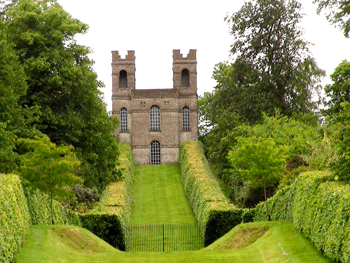
A Bridgeman garden, which appears slightly more natural
than the formal Baroque style, but still has a central axis
and straight lines
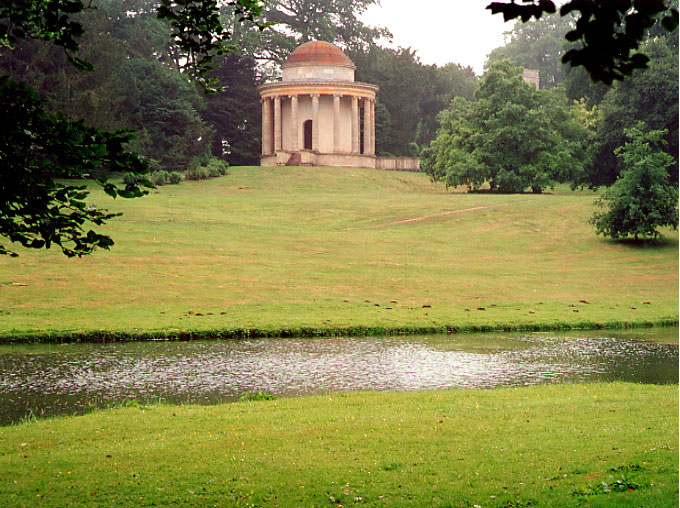
Yet Bridgeman’s garden wasn’t perfect; there is an uneasy tension between the two styles, with a strange mixture of formal water features near informal ponds, and parterres next to carefully designed fields and forests. William Kent began to resolve these problems by focusing more fully on the landscape, and leaving the formality of the French baroque behind. Kent found his inspiration from art, which reflects his artistic training earlier in life. In essence, his gardens were inspired by beautiful paintings, and he sought to sculpt nature to conform to an ideal. The central axis and straight lines of the past rapidly disappeared, and were replaced by curved lines and meandering pathways throughout the garden. Since he wanted to replicate paintings, he frequently constructed buildings, ancient ruins, and beautiful vistas, all of which appeared natural, but were in fact entirely manmade. His garden, then, was nothing but a theater; the plants, forests, and lakes were all actors, with carefully designed costumes and controlled emotions. In fact, it is believed that many of his gardens represent the concept of exempla virtutis, in which his gardens told stories that taught critical moral lessons about humanity. As a person strolled through the garden, they might come upon carefully placed statues and temples, which told an important story, but only to those that were highly educated in ancient mythology.

A Kent Garden, which shows gently rolling hills and a carefully placed "ancient" building


Capability Brown often worked in collaboration with Kent, although Brown’s landscapes tended to be subtler. Brown very infrequently used buildings or statues in his gardens, and instead relied on subtle sculpting of the landscape itself; nature, according to Brown, was inherently beautiful, but had “capability” to be improved. His gardens featured gently rolling hills and perfectly placed trees that were designed to show off the beauty of Earth. Some would call his gardens sparse, and, indeed, it is difficult to tell that the landscape is manipulated, let alone painstakingly designed. The manmade rivers, lakes, and forests looked entirely natural and unspoiled by human interaction. But that is precisely the point. Nature, in its purest form, was something that should be appreciated, and this message is quite obvious when walking through a Capability Brown garden. It isn’t hard to mistake a natural field for a garden, and one could argue that Brown would be happy if you did.
A Capability Brown garden, which looks much like a natural, untouched landscape


Sources:
http://www.jstor.org/stable/883610
http://www.jstor.org/stable/877243

Images
http://www.gardenvisit.com/assets/madge/claremont_landscape_garden2_/original/claremont_landscape_garden2__original.jpg
http://www.gardenvisit.com/assets/madge/stowe_ancient_virtue/original/stowe_ancient_virtue_original.jpg
http://textileandterrain.files.wordpress.com/2011/08/img_0077.jpg