The landscape garden was a
substantial change from the baroque garden, which dominated much of the
continent throughout the previous century. Since the baroque style was created
in France, the British were naturally opposed to it, and sought to make major changes
to their garden design. Enter the landscape garden, which was essentially the
exact opposite of the baroque, with flowing lines and rolling hills.
Charles Bridgeman was one of the
first proponents of this new garden style, and he provided an important
transition between the formality of the Baroque and the informality of the
Landscape. His gardens still featured a central axis and some straight lines,
but some curved paths also began to appear. The parterres were still present,
but the formality of the garden was disappearing, and so were the walls that
previously enclosed the gardens. Bridgeman is particularly noteworthy because
of the invention of the fossé, now called the ha-ha, which is a sunken wall
that is hidden from view, allowing the garden to merge with the surrounding
landscape. It is thought that the inspiration for this garden came from
medieval moats and canals, which were often relatively narrow and difficult to
see until the viewer closely approached the medieval castle. The wall was used
as a way to trick the viewer into thinking that the garden was much larger than
it actually was, thus making the garden, and its owner, much more impressive
and imposing. This larger-than-life garden was appealing to owners because it
provided a way to escape the confines, and stress, of daily life, and instead
allowed them to become more fully immersed in their mythical paradise that
seemed to stretch to, and beyond, the horizons.
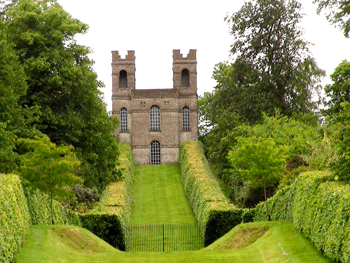 |
| A Bridgeman garden, which appears slightly more natural than the formal Baroque style, but still has a central axis and straight lines |
Yet Bridgeman’s garden wasn’t
perfect; there is an uneasy tension between the two styles, with a strange
mixture of formal water features near informal ponds, and parterres next to
carefully designed fields and forests. William Kent began to resolve these problems
by focusing more fully on the landscape, and leaving the formality of the
French baroque behind. Kent found his inspiration from art, which reflects his
artistic training earlier in life. In essence, his gardens were inspired by
beautiful paintings, and he sought to sculpt nature to conform to an ideal. The
central axis and straight lines of the past rapidly disappeared, and were
replaced by curved lines and meandering pathways throughout the garden. Since
he wanted to replicate paintings, he frequently constructed buildings, ancient
ruins, and beautiful vistas, all of which appeared natural, but were in fact
entirely manmade. His garden, then, was nothing but a theater; the plants,
forests, and lakes were all actors, with carefully designed costumes and
controlled emotions. In fact, it is believed that many of his gardens represent
the concept of exempla virtutis, in
which his gardens told stories that taught critical moral lessons about
humanity. As a person strolled through the garden, they might come upon
carefully placed statues and temples, which told an important story, but only
to those that were highly educated in ancient mythology.
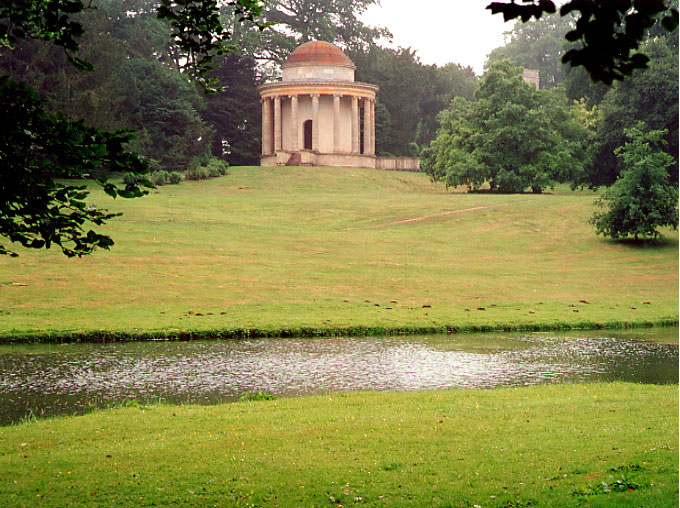 |
| A Kent Garden, which shows gently rolling hills and a carefully placed "ancient" building |
Capability Brown often worked in
collaboration with Kent, although Brown’s landscapes tended to be subtler.
Brown very infrequently used buildings or statues in his gardens, and instead
relied on subtle sculpting of the landscape itself; nature, according to Brown,
was inherently beautiful, but had “capability” to be improved. His gardens
featured gently rolling hills and perfectly placed trees that were designed to
show off the beauty of Earth. Some would call his gardens sparse, and, indeed,
it is difficult to tell that the landscape is manipulated, let alone
painstakingly designed. The manmade rivers, lakes, and forests looked entirely
natural and unspoiled by human interaction. But that is precisely the point.
Nature, in its purest form, was something that should be appreciated, and this
message is quite obvious when walking through a Capability Brown garden. It isn’t
hard to mistake a natural field for a garden, and one could argue that Brown
would be happy if you did.
 |
| A Capability Brown garden, which looks much like a natural, untouched landscape |
Sources:
http://www.jstor.org/stable/883610
http://www.jstor.org/stable/877243
Images
http://www.gardenvisit.com/assets/madge/claremont_landscape_garden2_/original/claremont_landscape_garden2__original.jpg
http://www.gardenvisit.com/assets/madge/stowe_ancient_virtue/original/stowe_ancient_virtue_original.jpg
http://textileandterrain.files.wordpress.com/2011/08/img_0077.jpg

No comments:
Post a Comment