The Battle of Styles is an apt name for a period of change
that was occurring in gardens during the late 19
th century. The
‘battle’ in the Battle of Styles was real, as William Robinson and Reginald
Blomfeld, the two main opponents, somewhat viciously attacked each other, in an
attempt to win the war. Ironically, this was probably unnecessary, as both men
could have been united in their common enemy: the Victorian garden. Yet they
instead traded harsh criticism in magazines and book forewords, each more biting
than the last.
 |
| A Robinson garden, with numerous hardy plants |
On one side of the battle was William
Robinson, a well-known gardener that strongly favored the natural over the
artificial. He shunned the use of geometric shapes and excessive fountains or
statues, and harshly criticized Versailles, considered among the nicest gardens
in the world, as “unlovely.” Unsurprisingly, then, his gardens featured a
lighter touch; he used plants and shrubbery to add color and drama to his
gardens, while foregoing elaborate statues and water features. His gardens also
featured some shrubs and trees, which also required minimal maintenance. These
shrubs were used for simple borders, and he detested the formality of patterned
hedges and topiary, as well as the use of greenhouses to grow tropical plants.
He primarily used hardy plants,
like fennel and reeds, to create a colorful, complex garden that required
little upkeep. These plants could easily survive the winter, and then flower
the next spring, even if forgotten. His use of these plants earned him the
nickname of the ‘practical gardener,’ which may have stemmed from his simple
Irish upbringing. Although little is definitively known about his childhood, it
is believed that he grew up on a small farm in Ireland, and likely had a
relatively modest childhood. Thus, a garden that required little upkeep would
have seen especially attractive to a boy that was likely kept busy with family
chores. Indeed he used so many plants that the soil was essentially totally covered,
preventing weeds from growing. The result was quite simply beautiful—a sea of
flowers with different colors, patterns, and heights that made for an elaborate
garden that appeared like a natural field of flowers.
 |
| A more formal Blomfield garden, note the straight lines and classical architecture |
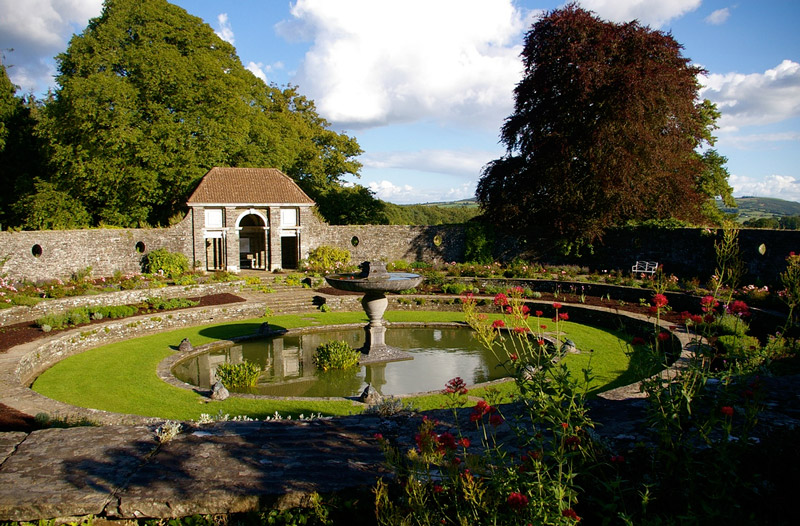
The other
side of the debate featured Reginald Blomfield, an architect who, naturally,
thought that gardens should be designed by the architect, and not the gardener.
This led to gardens that were more formal and elaborate, and integrated into
the architecture of the house. Blomfield found his inspiration in both the
French and Italian Renaissance, and he correspondingly favored very formal
gardens. These gardens featured straight lines, carefully arranged flowers, and
clipped hedges. Together, this created a “homogenous result” that closely
linked the house and the garden together. These gardens were large, and
featured numerous terraces, as well as a variety of vases, sundials, and
Renaissance-inspired statues, which were universally despised by Robinson. This
made the garden more like a piece of art, and it appeared more stylized and
designed than Robinson’s garden.
Who won the battle? Probably
neither. It could be argued that Robinson won, as public sentiment was clearly
on his side. The English Flower garden flourished in houses around England, and
the popularity of densely packed gardens filled with hearty plants increase
dramatically, and is still seen today. However, Robinson continued to berate
architects for much of his life, accusing them of having no skill, which lessen
his respect within the community. And indeed many architects did have
prodigious skill, but would need a gardener to actually care for the plants.
Perhaps, then, the battle was really a draw, and that neither could excel
without the other.
Eventually, a
partnership would arise between gardener and architect, again proving that
working together is a better alternative than working apart. That is not to say
that Blomfield and Robinson ever worked together, instead it would take a new
architect-gardener pair, Jekyll and Lutyens, to form a team that would
revolutionize gardening and create the arts and crafts garden.
 |
| The winner of the battle- Jekyll and Blomfield gardens |



No comments:
Post a Comment