Question: What is the connection, and what are the similarities, between Renaissance gardens and dance?
It’s well known that politics, history, and religion have strongly influenced garden culture throughout the ages. Art, too, closely overlaps with garden design and there are important connections between art and gardens. However, when we talk about “art,” we usually limit ourselves to the sculptures and murals found throughout Renaissance gardens. In essence, we limit our analysis to the visual arts, never stopping to consider the connection between gardens and the performing arts. There is something inexplicable beautiful and graceful about gardens and performance, yet the connection between the two is, I believe, highly underdeveloped. In particular, there are many similarities between gardens and dance during the Renaissance times, and some garden features may have been drawn directly from changes and developments in choreography.
It’s well known that politics, history, and religion have strongly influenced garden culture throughout the ages. Art, too, closely overlaps with garden design and there are important connections between art and gardens. However, when we talk about “art,” we usually limit ourselves to the sculptures and murals found throughout Renaissance gardens. In essence, we limit our analysis to the visual arts, never stopping to consider the connection between gardens and the performing arts. There is something inexplicable beautiful and graceful about gardens and performance, yet the connection between the two is, I believe, highly underdeveloped. In particular, there are many similarities between gardens and dance during the Renaissance times, and some garden features may have been drawn directly from changes and developments in choreography.
 |
| One section of garden at Villa L'Ambrogiana; note how this garden features several axes and geometric figures, similar to many Renaissance dance pieces |
 |
| "Square Circles" |
The pattern of both gardens and
dance are surprisingly similar, and since many of the finest works of European
Renaissance dance were being performed while the demand for gardens
skyrocketed, it is possible that choreography had some influence in garden
design. In particular, the renewed interest in geometric design may have been
influenced by dance. Many of the newly designed pieces during the Renaissance
time placed a specific influence on geometric movement and formations, which
did not play a role in previous centuries. The new desire to have symmetry and
central axes, seen in both gardens and
dance, were part of this new interest in geometry. But looking beyond these
simple features, more complex gardens, such as the gardens at Padua, was
designed to have square gardens within concentric circles, with each bed
further divided with plants and flowers of different colors or shapes. Square
formations that descend into circles is a classical ballet combination, and
many dance styles frequently use ornate costuming to provide color and visual
interest; some dance pieces from this time, like Dolce Amoroso Foco, showed this type of choreography. Others, like
the gardens at L’Ambrogiana (Florence), also have sections that closely mimic the
formation used in this dance piece. Renaissance dance made several formations
quite famous, such as the “square circle” which is seen reflected in gardens,
such as the ones at Villa Petraia (Florence). If you stop to consider one small
section of a formal garden, it is not hard to imagine dancers moving down the
central axes and then moving gracefully outward in all directions, perhaps pirouetting
around circular beds or moving down linear pathways to the ends of the stage.
During both
the 15th and 16th centuries, there were major changes in
art throughout Europe, and this can easily be seen in both gardens and choreography.
In principle, both share a unique desire to control. Renaissance gardens,
especially formal gardens, were masterpieces of design, with carefully designed
knot gardens and artistic water features that showed man’s supreme dominance
over nature. Dance too is a way to control, to force the human body to assume
dramatic poses and unnaturally graceful movement. Like formal Renaissance
gardens, dance is a carefully designed pattern that is designed to show beauty
and creativity, as well as a complete mastery over nature, in this case, the
human body.
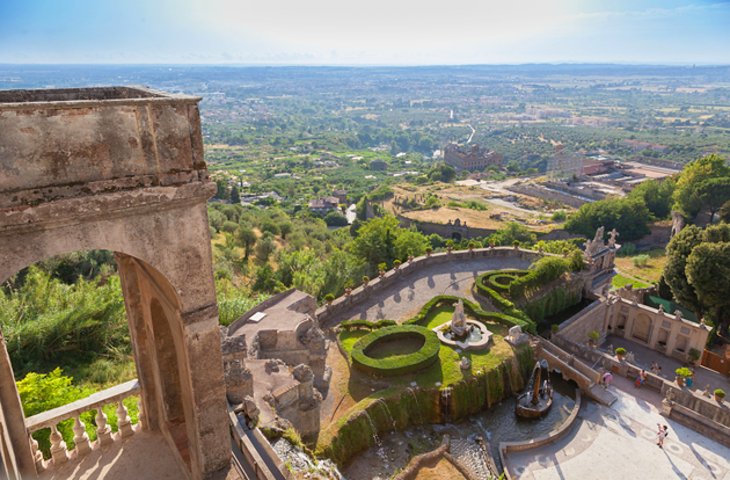 |
| Villa d'Este from above |
Both gardens and dance are designed
to be viewed from above. Consider an Italian Renaissance garden like Villa
d’Este, where the house is intentionally built above the garden, so one can
look out above the entire garden, seeing the intricate pattern and design that
makes the garden so beautiful. While the garden can certainly be appreciated
from ground level, the pure magnificence of the entire production is seen from
above. Similarly, most dance performances are meant to be seen from above
(don’t buy those front row seats), so you can appreciate the pattern that the
entire troupe forms as a whole. In Renaissance times, it was not unusual for a
dance piece to be performed outside of the castle, with nobles and
distinguished guests viewing the performance from the highest windows of the
castle, or perhaps even from a raised garden or a mound garden.
Finally, perhaps the most obvious
connection between these two forms of art is extravagance. Gardens were made
with the express desire to show off immeasurable wealth, with huge terraces,
beautiful statues, and ornate water features. Only the richest aristocracy
during this time could commission dance pieces, usually ballets, which were
performed during special occasions and holidays. Naturally, hiring and training
an entire dance troupe is extremely expensive, but one that would impress
guests and win over hearts. Both gardens and dance showed the splendor and
magnificence of the time, and each is equally awe-inspiring, both in Renaissance
times and in modern society.
Sources
Sources
http://rostik.1gb.ru/dance/Jennifer%20Nevile,%20Dance%20and%20the%20Garden%20Moving%20and%20Static%20Choreography%20in%20Renaissance%20Europe%20(1999).pdf
http://www.jstor.org/stable/880087 (JSTOR subscription required)

Fascinating post. Have to confess that while I know gardens were used as locations for performances, I had not considered the impact of dance on garden design.
ReplyDeleteAs a dance major and landscape studies minor, I love this post! I have worked with dance and garden art quite a bit in my classes, but have been trying to connect the two disciplines - especially for my senior thesis. You have made very keen observations and skillfully explained their connections. I love your point that we often limit ourselves by only discussing the connection between gardens and visual arts. You also drew interesting parallels - geometric patterning, the "square circle," and viewing both from above. Have you experienced any performance art in gardens during your travels? I haven't, but I think that they would be an ideal venue for dance!
ReplyDeleteSadly I never did experience any art in a garden. The closest I came to art in a park was some painters and musicians in Italy, but I never really saw any actual dancers. I've never really seen any dance done in a garden, have you? I think it would be beautiful though, and a great way to show the deep, personal interaction between the garden (nature) and the humans that occupy it. I've seen several beautiful gardens throughout Europe and a ballet in Copenhagen, and I think the combination of the two would be simply perfect.
Delete