The renaissance was a time of
amazing discovery, but also a time to rediscover much of what had been lost
from previous cultures. In particular, people involved in the Italian
Renaissance found a new affection for the Ancient Greeks and Ancient Romans.
This affection can be seen throughout much of the work produced during this
era—everything from architecture to statues to gardens.
In addition to this crucial
rediscovery of ancient cultures, the Renaissance people literally expanded the
world by discovering new continents and islands. Gardens soon became a way to
show off the treasures of the New World and faraway lands, as the rich began to
fill their gardens with plants and herbs discovered from all four corners of
the globe. The sheer variety of plants was impressive, but it also allowed
scientists and botanists to study plants, which fulfilled the basic desire of
the times to learn more about and explain the behavior of nature.
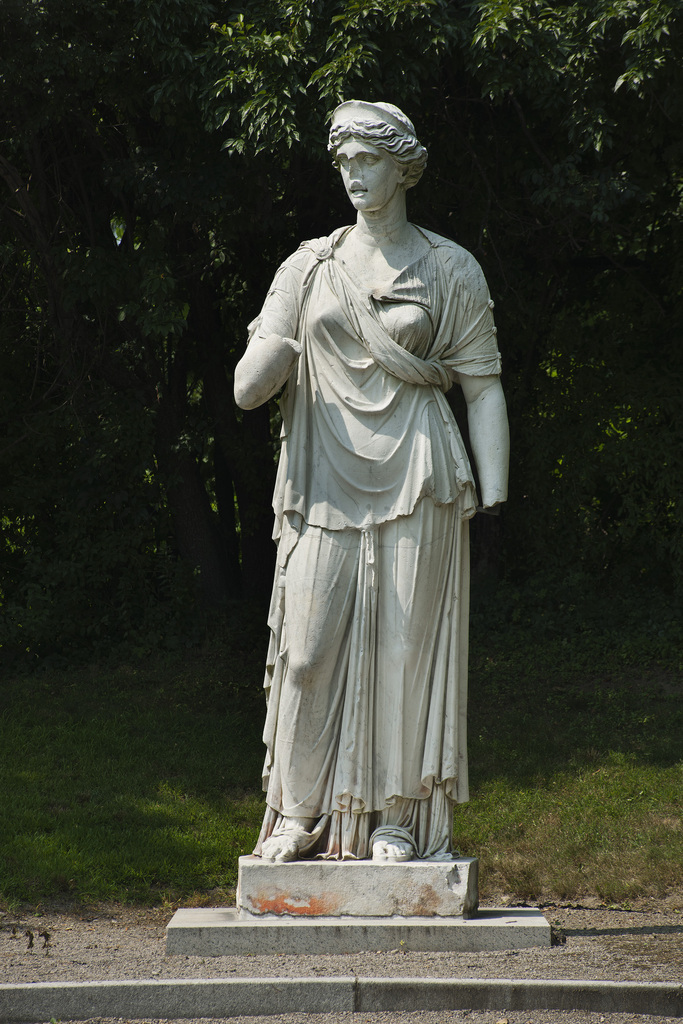 |
| Renaissance statue |
While Renaissance gardens were
academically useful, they were also beautiful pieces of art that were often
designed and maintained by professional staff. These gardens were quite
ornamental, and frequently contained many statues and sculptures, which were
also featured prominently in Ancient Roman and Greek gardens. These statues
ranged from religious to comedic, and frequently feature humans depicted in a
surprisingly accurate way. Perhaps unsurprisingly the statues in the
Renaissance gardens bear stunning resemblances to works from these other
ancient societies, and in some cases, the statues are exact replicas.

 |
| Note the similarities between the Renaissance garden (top) and an Ancient Roman garden (bottom) |
That’s not to say that the entire
garden was merely a copy of an ancient manuscript. Although scholars during
this timeframe discovered, and practically worshipped, books and manuscripts
from centuries gone by, the renaissance was also filled with new ideas and
amazing discoveries. One of the major tenets of the time period was a
rediscovery of nature, which was manifested via scientific study and a strong
desire to control nature.
This desire to control nature is
often seen in Renaissance gardens, and many scholars refer to this as the
“third nature.” The third nature is a mix of first nature (pure, unmodified Earth)
and second nature (land manipulated by humans to form farmland, fields, and
towns). Obviously nature controls the environment and plant growth, but the rigid,
geometrical design of the garden, as well as an obsession with a central axis,
show that humans too can strongly manipulate the land. There is a constant struggle
between human and nature in gardens, and also in much of Renaissance society; each
attempts to control the other, with varying degrees of success.
Interestingly, many Renaissance
gardens actually try to imitate the first nature by designing rock formations and
grottoes, as well as conveniently placing rocks and trees to control the path
of a natural stream. By imitating nature, the Renaissance man showed that not
only was he able to control nature, but also that he could replicate and
improve it. It was quite a powerful thought, but one that reflects strongly
upon the new belief that humans were capable and rational beings that had some
degree of control over their surroundings.
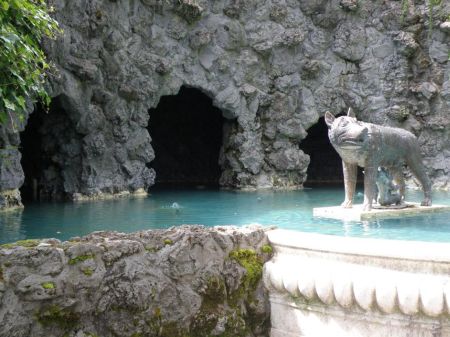 |
| Italian Renaissance grotto |
Sources
Pictures
http://hamiltongardens.co.nz/file/collection1/images/large/46.jpg?v=1289507737
http://www.thecultureconcept.com/circle/wp-content/uploads/2010/11/View-Getty-Villa-from-Courtyard-Garden-with-Sculpture1.jpg
http://fennerschool-associated.anu.edu.au/environhist/newzealand/journal/2009/dec/images/doube/fig01.jpg
http://www.thehistoryblog.com/wp-content/uploads/2012/03/MFA_Juno.jpg

I think it is interesting how gardens were used to show that man had control over nature; that by building an incredible garden one was able to show dominance over nature, and thus over the people he ruled or lead. I know when I used to look at gardens I did not consider the power of the builder (or usually fund-er in this case), but instead the magnificence of the creation itself. Now I am forced to look at the Renaissance gardens in a whole new light.
ReplyDeleteBut through examining, controlling and in some cases imitating nature through art, Renaissance man came to understand nature better, and thus, too the works of God
ReplyDelete